About Us
FishPAC Areas
The California Fish Passage Advisory Committee consists of six major areas throughout the state, which is comprised of 10 Caltrans districts. Caltrans districts 8 and 9 are not included, since they have no anadromy.
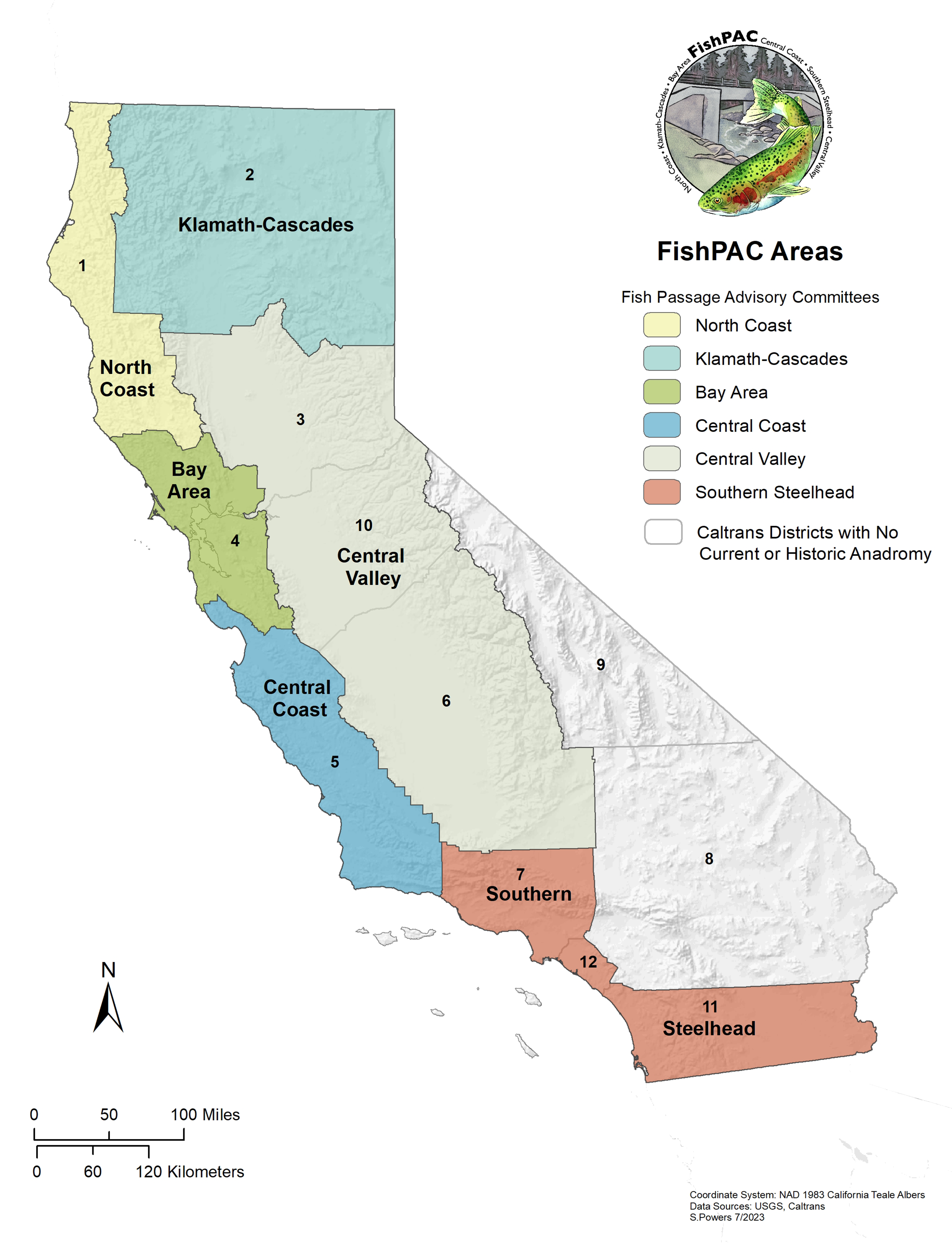
Click image to expand
California Fish Passage Advisory Committee
| FISHPAC | CALTRANS DISTRICT | CDFW REGION | NFMS OFFICE | COUNTIES With Current Habitat, Historic Habitat, or Known Fish Barriers on the State Highway System | FISH SPECIES & LISTING STATUS (T = Threatened | E = Endangered | S = Species of Concern) |
|---|---|---|---|---|---|
| North Coast est. 2003 |
1 – Eureka | 1 – Northern | Arcata, Santa Rosa |
|
|
| Klamath-Cascades est. 2007 |
2 – Redding | 1 – Northern 2 – North Central |
Arcata, Sacramento |
|
|
| Bay Area est. Sept. 2016 |
4 – Oakland | 3 – Bay Delta | Santa Rosa |
|
|
| Central Coast est. Aug. 2017 |
5 – San Luis Obispo | 3 – Bay Delta 4 – Central 5 – South Coast |
Santa Rosa |
|
|
| Central Valley est. Nov. 2018 |
3 – Marysville 6 – Fresno 10 – Stockton |
2 – North Central 3 – Bay Delta 4 – Central |
Sacramento |
|
|
| Southern Steelhead est. Feb. 2017 |
7 – Los Angeles 11 – San Diego 12 – Orange |
5 – South Coast | Long Beach |
|
|
FishPAC’s are comprised of fish passage partners from agencies and non-profits, including:
- 5-Counties Salmonid Conservation Program
- California Conservation Corps
- California State Coastal Conservancy
- California Trout
- Pacific States Marine Fisheries Commission
- Tribal Fisheries Experts
- Trout Unlimited
- U.S. Fish and Wildlife Service
- U.S. Forest Service
- Other Organizations
FishPAC Leadership Team
Leads
Melinda Molnar
Fish and Wildlife Program Manager, Caltrans
Jim Walth
Senior Fish Biologist, Caltrans
Zack Larson
Senior Fish Biologist, Caltrans
Team
Shawna Pampinella
Chief Office of Biological Studies, Caltrans
Derek Acomb
Senior Environmental Scientist (Fisheries), CDFW
Rosi Dagit
Resource Conservation District of the Santa Monica Mountains
Caitlin De La Torre
Environmental Compliance and Stewardship, Caltrans District 4
Brad Henderson
Cutting the Green Tape Environmental Program Manager, CDFW
Jim Henke
Office Chief of Biology, Caltrans District 10
Rick Macala
Senior Hydraulic Engineer, CDFW
Wes Stroud
Office Chief North Region Environmental, Caltrans District 2
Nanette Nickerson
District Hydraulics Engineer, Caltrans District 1
Sarah Sandstrom
Senior Environmental Scientist (Specialist) - Aquatic Resource Biologist - Fish Passage Coordinator, Caltrans District 5
The Leadership Team mission is to support fish passage remediation by addressing complex challenges that FishPACs encounter, supporting effective and innovative engineering solutions, and advocating for FishPAC decisions using sound science and data. In addition, they provide support as other needs are identified, identify challenges to advancing fish passage barrier remediation, make recommendations and participate in the implementation of strategies that advance the goals of the FishPACs.